Certified AI in Policy & Governance (CAIPG) ™
The exam validates a candidate’s ability to apply foundational concepts, regulatory frameworks, governance models, ethical considerations, operational implementation principles, and auditing/evaluation techniques relevant to AI governance in the public sector.
Self-paced Course
Learn with labs & projects at your own pace.
Practice Exam
Timed questions with instant feedback & review.


Governance capacity is now a delivery requirement.
Public-sector AI is increasingly evaluated on rights, accountability, and operational controls—not only technical performance. CAIPG organizes the essentials into an assessment-ready structure.
Regulation is moving from principles to practice
Governments need staff who can translate legal and ethical requirements into operational controls—risk assessments, documentation, oversight roles, and redress.
Accountability needs clear structures
Centralized, distributed, and hybrid governance models each introduce trade-offs. Effective oversight depends on defined mandates, escalation paths, and capacity.
Implementation is where risk shows up
Procurement clauses, pilots, monitoring dashboards, and incident response determine whether AI improves services without undermining equity, due process, or trust.
Exam Curriculum
The CRAIS certification covers a comprehensive curriculum designed to equip professionals with the knowledge and skills to navigate the complex landscape of responsible AI.
Foundations & Policy Context
Define AI, ADS/ADM, and algorithmic systems in public services Connect policy rationales: efficiency, equity, accountability, resilience Understand digital-by-default strategies and legitimacy Interpret global policy actors (OECD, UNESCO, GPAI) at a high level
Legal & Regulatory Frameworks
Apply due process, non-discrimination, transparency, legal certainty Understand risk-based regulation and conformity expectations Distinguish hard law vs soft-law guidance instruments Recognize cross-border compliance and sectoral overlays
Governance & Institutional Design
Compare centralized, distributed, and hybrid oversight architectures Design roles for regulators, DPAs, auditors, ethics bodies, ombuds Use model cards, AI registries, impact assessments for accountability Plan escalation paths, checks & balances, and capacity building
AI Policy Tools & Instruments
Embed governance in procurement: clauses, documentation, audit rights Use sandboxes, pilots, testing labs, standards, and certifications Understand open data, data trusts, anonymization & differential privacy Combine incentives + enforcement into coherent tool ecosystems
Ethics, Equity & Social Impacts
Evaluate fairness, bias, contestability, explainability, and dignity Address privacy, surveillance, consent limitations, and redress Recognize digital divide and workforce impacts Incorporate sustainability and environmental justice considerations
Public Sector AI Implementation
Map lifecycle: design → procurement → deployment → monitoring/audit Implement HITL with meaningful oversight and anti-automation-bias controls Run pilots, shadow mode, phased rollout, and kill-switch procedures Integrate logging, audit trails, and multidisciplinary governance teams
Evaluating & Auditing AI in Government
Define KPIs and evaluate performance, fairness, and trust impacts Conduct audits: scope, documentation review, testing, and reporting Use red teaming, adversarial testing, stress tests, calibration checks Establish learning loops from incidents to governance updates
International Coordination & Future Trends
Understand international principles, norms diffusion, and coordination Navigate cross-border data flows, localization, and jurisdiction conflicts Assess frontier & generative AI risks: misinformation, dual-use, safety Apply foresight, resilience planning, and adaptive regulation approaches
Syllabus Weightage
Sample Examination
Experience the scenario-based methodology used in GIofAI professional assessments.
Tip: GIofAI scenario questions often present multiple technically "valid" options. You must choose the one that aligns best with the FATE (Fairness, Accountability, Transparency, and Explainability) framework and institutional risk policy.
GIofAI Exam Portal
A world-class testing interface designed for precision, security, and accessibility.
Clean, Distraction-Free UI
Our portal uses a high-contrast, minimalist design to help you focus on complex case studies.
Integrated Utility Tools
Access on-screen scientific calculators, fairness metric scratchpads, and translation assistants.
Safe Exam Browser
Institutional-grade lockdown technology ensures the integrity of your professional designation.
Flexible Session Management
Auto-save features and interruption-recovery protocols protect your progress against connectivity drops.
Logistics & Compliance
Global delivery with institutional security standards.
Exam Format
Retake Policy
-
Up to 2 retakes permitted within a 6-month period.
-
Each retake requires a separate examination purchase.
-
Practice Exam completion is strongly recommended prior to retake attempts.
Scoring & Results
No Negative Marking
Candidates are encouraged to answer all 250 questions; there is no penalty for incorrect answers.
Instant Provisionals
View your provisional result immediately upon submitting your examination session.
Official Transcript
Verified certificate and transcript will be available in your dashboard within 48 hours.
Verified Identity
Biometric and government ID verification is mandatory for all candidates via the web-based portal.
Transcript & Certificate
Official documentation of your certification achievement.
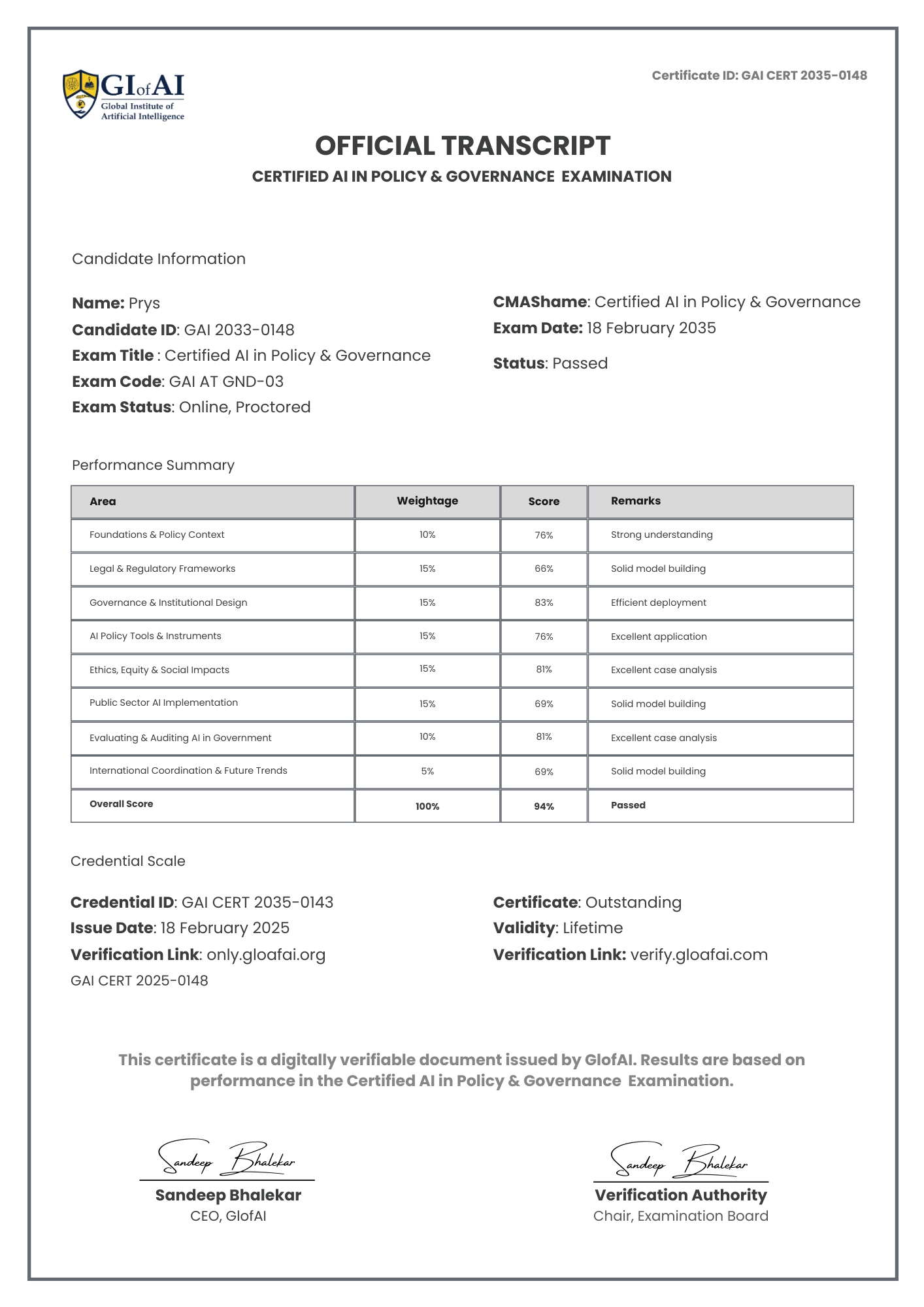
Official Transcript
Your verified transcript includes detailed performance metrics and section-wise scores.
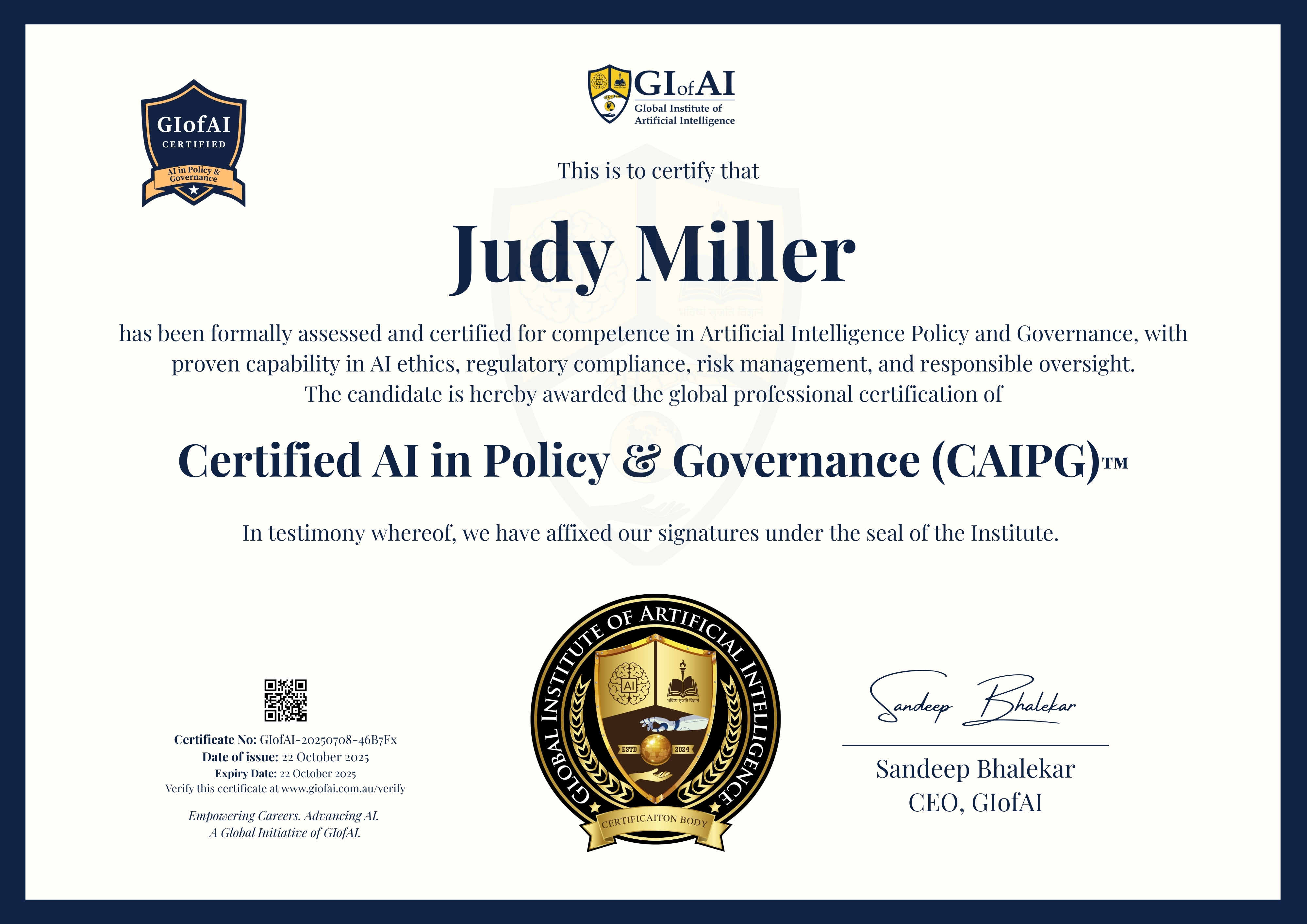
Digital Certificate
Your professional certification credential, verifiable and shareable.
Frequently Asked Questions
If you have a question not covered here, use the chat widget for guidance and next steps.
CAIPG is aimed at policymakers, regulators, civil servants, AI ethics & governance practitioners, public-sector technology leaders, and consultants supporting digital government—especially those working on citizen-impacting AI use cases.
No. The live assessment is closed book and delivered online under remote proctoring conditions. Plan to rely on recall and application across the eight domains.
The pass threshold is 70% (at least 39 correct out of 55). Each question carries one mark and there is no negative marking.
Use the weightage map: prioritize the 15% domains (legal/regulation, governance design, policy tools, ethics, implementation), then reinforce foundations and evaluation/auditing. Practice scenario reasoning around safeguards, transparency, and redress.
Yes—retakes are permitted. Use the first attempt to diagnose weak domains and improve performance with focused study on governance instruments, implementation controls, and audit/evaluation patterns.
Ready to validate public-sector AI governance capability?
Register for CAIPG to demonstrate policy-to-operations readiness: interpret governance frameworks, design oversight models,implement controls, and evaluate AI systems for accountability and trust.

Career Path
A progression from entry to leadership, aligned with certifications.
Entry-Level Roles
- AI Practitioner
- Junior AI Engineer
- Data Analyst / AI Technician
Intermediate Roles
- Machine Learning Engineer
- Data Scientist
- Generative AI Developer
- Computer Vision Engineer
- Cloud AI Engineer
- Responsible AI Specialist
Advanced Roles
- AI Consultant (Finance, Healthcare, Manufacturing, etc.)
- AI Solutions Architect
- AI Research Engineer
- AI Security & Privacy Specialist
Leadership Roles
- AI Product Manager
- Head of AI / Director of Data Science
- AI Transformation Officer
- Chief AI Officer (CAIO)
- AI Governance & Risk Director
Entry-Level Roles
- AI Practitioner
- Junior AI Engineer
- Data Analyst / AI Technician
Advanced Roles
- AI Consultant (Finance, Healthcare, Manufacturing, etc.)
- AI Solutions Architect
- AI Research Engineer
- AI Security & Privacy Specialist

Intermediate Roles
- Machine Learning Engineer
- Data Scientist
- Generative AI Developer
- Computer Vision Engineer
- Cloud AI Engineer
- Responsible AI Specialist
Leadership Roles
- AI Product Manager
- Head of AI / Director of Data Science
- AI Transformation Officer
- Chief AI Officer (CAIO)
- AI Governance & Risk Director
Career Growth Ladder
| Level | Typical Roles | Relevant Certifications |
|---|---|---|
| Entry-Level | AI Technician, Data Analyst | CAIP |
| Mid-Level | AI Engineer, ML Engineer, AI Developer | CAIE, CRAIS, CGAIS |
| Advanced | AI Architect, AI Consultant, Security Specialist | CLLMS, CCVE, CAICE, CAISPS, Industry Certs |
| Leadership | Head of AI, AI Product Manager, CAIO | CAIL, CAITO, CAIGR, CEAIR |

Certification Pathway
GlofAI Learning Path (Certification Progression)
Stage 1 — Foundation
Stage 2 — Core AI Competency
- Certified AI Engineer (CAIE) – Core technical certification.
- Certified Responsible AI Specialist (CRAIS) – Ethics, bias mitigation, compliance.
- Certified Generative AI Specialist (CGAIS) – Prompt engineering, generative AI tools.
Stage 3 — Specialized Technical Expertise
- Certified LLM Specialist (CLLMS) – NLP & Large Language Models.
- Certified Computer Vision Expert (CCVE) – Imaging, video analytics, AR/VR.
- Certified AI Cloud Engineer (CAICE) – AI on AWS, Azure, GCP, Databricks.
- Certified AI Security & Privacy Specialist (CAISPS) – AI risks, privacy, cybersecurity.
Stage 4 — Industry-Specific Applications
- Finance & Banking: Certified AI in Financial Services (CAIFS)
- Healthcare: Certified AI in Healthcare (CAIH)
- Retail & Supply Chain: Certified AI in Retail & Supply Chain (CAIRSC)
- Manufacturing: Certified AI in Manufacturing (CAIM)
- Public Sector & Policy: Certified AI in Policy & Governance (CAIPG)
Stage 5 — Executive & Enterprise Leadership
- Certified AI Leader (CAIL) – Strategic, leadership-level AI management.
- Certified AI Transformation Officer (CAITO) – C-suite strategy & transformation.
- Certified Enterprise AI Ready (CEAIR) – AI governance framework for organizations.
- Certified AI Governance & Risk Expert (CAIGR) – Compliance & regulatory strategy.

Stage 1 — Foundation
Goal: Build baseline AI knowledge and confidence.
Certified AI Practitioner (CAIP) – Foundational skills in AI, data, and ML.
Stage 2 — Core AI Competency
Goal: Master model development and deployment.
- Certified AI Engineer (CAIE) – Core technical certification.
- Certified Responsible AI Specialist (CRAIS) – Ethics, bias mitigation, compliance.
- Certified Generative AI Specialist (CGAIS) – Prompt engineering, generative AI tools.
Stage 3 — Specialized Technical Expertise
Goal: Deep dive into specific domains of AI technology.
- Certified LLM Specialist (CLLMS) – NLP & Large Language Models.
- Certified Computer Vision Expert (CCVE) – Imaging, video analytics, AR/VR.
- Certified AI Cloud Engineer (CAICE) – AI on AWS, Azure, GCP, Databricks.
- Certified AI Security & Privacy Specialist (CAISPS) – AI risks, privacy, cybersecurity.
Stage 4 — Industry-Specific Applications
Goal: Apply AI to real-world sectors.
- Finance & Banking: Certified AI in Financial Services (CAIFS)
- Healthcare: Certified AI in Healthcare (CAIH)
- Retail & Supply Chain: Certified AI in Retail & Supply Chain (CAIRSC)
- Manufacturing: Certified AI in Manufacturing (CAIM)
- Public Sector & Policy: Certified AI in Policy & Governance (CAIPG)
Stage 5 — Executive & Enterprise Leadership
Goal: Lead AI strategy and enterprise adoption.
- Certified AI Leader (CAIL) – Strategic, leadership-level AI management.
- Certified AI Transformation Officer (CAITO) – C-suite strategy & transformation.
- Certified Enterprise AI Ready (CEAIR) – AI governance framework for organizations.
- Certified AI Governance & Risk Expert (CAIGR) – Compliance & regulatory strategy.
| Level | Focus | Example Certifications |
|---|---|---|
| Beginner | Foundations | CAIP |
| Intermediate | Core AI Skills | CAIE, CRAIS, CGAIS |
| Advanced | Specialized Technical | CLLMS, CCVE, CAICE, CAISPS |
| Expert | Industry Applications | CAIFS, CAIH, CAIRSC, CAIM, CAIPG |
| Leader | Strategic & Enterprise | CAIL, CAITO, CEAIR, CAIGR |