Finance & Banking: Certified AI in Financial Services (CAIFS)™
The exam validates a candidate’s ability to apply foundational concepts, practical skills, and best practices in AI in Financial Services to real-world scenarios.
Self-paced Course
Learn with labs & projects at your own pace.
Practice Exam
Timed questions with instant feedback & review.


AI capability is now a regulated advantage
Financial services teams are expected to deliver measurable AI outcomes—while maintaining auditability, fairness, and model risk controls.
AI is moving from pilots to production
Banks, insurers, and asset managers are scaling AI for decisioning, operations, and client experience—requiring professionals who can translate business needs into deployable, monitored systems.
Trust, explainability, and controls
Model risk management, documentation, validation, and audit trails are non-negotiable. Demonstrating competence in these areas helps teams ship AI responsibly and sustainably.
New interfaces, new risks
Generative AI is expanding into research, operations, and compliance workflows. Teams need clear patterns—like access-controlled retrieval and human oversight—to avoid unintended exposure and errors.
Exam Curriculum
The CRAIS certification covers a comprehensive curriculum designed to equip professionals with the knowledge and skills to navigate the complex landscape of responsible AI.
Foundations of AI in Financial Services
Financial services landscape: banking, markets, payments, insurance, wealth & asset management. AI vs ML vs statistical models in a financial context. Financial data types: transactional, behavioral, market, reference, and unstructured documents. AI/ML lifecycle: framing → data → modeling → deployment → monitoring. Risks & limitations: explainability, data quality, and black-box concerns.
Data Engineering & AI Infrastructure in Finance
Data sources & pipelines: core banking, trading, CRM, KYC/AML, market data vendors. Architectures: data lakes, warehouses, lakehouse patterns; batch vs streaming pipelines. Data quality, lineage, metadata management for regulated environments. Feature engineering & feature stores for risk, fraud, personalization. Infra controls: access, encryption at rest/in transit; on-prem/cloud/hybrid patterns.
AI Use Cases in Banking & Capital Markets
Credit decisioning, segmentation, next-best-offer, churn prediction, and collections optimization. Trade surveillance, anomaly detection, and NLP for research and news summarization. Document understanding for KYC/onboarding/loan docs and workflow automation. GenAI co-pilots for relationship managers/traders with approved knowledge sources. Scenario selection: choosing the right approach for a given business problem.
AI in Risk Management & Fraud Detection
Credit risk concepts: PD, LGD, EAD; scorecards vs ML trade-offs. Fraud & AML: anomaly detection, graph methods, false positive reduction, alert triage. Stress testing & scenario analysis (high level). Operational risk & conduct risk signals (conceptual). Monitoring: drift detection and sensitivity vs precision threshold tuning.
AI in Wealth, Investment & Insurance
Wealth: robo-advisory concepts, risk profiling, personalization for advisors. Research: NLP over filings and disclosures; GenAI summarization with human oversight. Insurance: underwriting support from structured/unstructured inputs. Claims triage and automation; fraud detection in claims. Workflow integration in advisor/underwriter portals and client reporting.
Regulatory Compliance, Governance & Model Risk
Governance lifecycle: inventory → validation → approval → deployment → review → retirement. Documentation standards: model dev docs, validation reports, change logs. Model risk categories: data, implementation, conceptual, and use issues. Auditability & traceability; backtesting, challenger models, and overrides. Independent validation and benchmarking as part of sound MRM practice.
Responsible & Ethical AI in Finance
Fairness & non-discrimination in lending, pricing, and customer treatment. Explainability: local vs global explanations; practical requirements for decisions. Human oversight: escalation, human-in-the-loop, and appeals processes. Customer transparency about AI use and automation limits. Internal policies and governance committees for higher-risk use cases.
Emerging Trends & Future of AI in Financial Services
GenAI in finance: co-pilots, document automation, conversational enterprise interfaces. AI + digital assets/DeFi/CBDCs (high level): analytics, surveillance, and risk signals. Real-time payments and embedded finance: AI for instant risk and fraud decisions. Operating models: talent, standards, and centers of excellence. Scenario questions: future-proof roadmaps aligned to strategy and risk appetite.
Syllabus Weightage
Sample Examination
Experience the scenario-based methodology used in GIofAI professional assessments.
Tip: GIofAI scenario questions often present multiple technically "valid" options. You must choose the one that aligns best with the FATE (Fairness, Accountability, Transparency, and Explainability) framework and institutional risk policy.
GIofAI Exam Portal
A world-class testing interface designed for precision, security, and accessibility.
Clean, Distraction-Free UI
Our portal uses a high-contrast, minimalist design to help you focus on complex case studies.
Integrated Utility Tools
Access on-screen scientific calculators, fairness metric scratchpads, and translation assistants.
Safe Exam Browser
Institutional-grade lockdown technology ensures the integrity of your professional designation.
Flexible Session Management
Auto-save features and interruption-recovery protocols protect your progress against connectivity drops.
Logistics & Compliance
Global delivery with institutional security standards.
Exam Format
Retake Policy
-
Up to 2 retakes permitted within a 6-month period.
-
Each retake requires a separate examination purchase.
-
Practice Exam completion is strongly recommended prior to retake attempts.
Scoring & Results
No Negative Marking
Candidates are encouraged to answer all 250 questions; there is no penalty for incorrect answers.
Instant Provisionals
View your provisional result immediately upon submitting your examination session.
Official Transcript
Verified certificate and transcript will be available in your dashboard within 48 hours.
Verified Identity
Biometric and government ID verification is mandatory for all candidates via the web-based portal.
Transcript & Certificate
Official documentation of your certification achievement.
Official Transcript
Your verified transcript includes detailed performance metrics and section-wise scores.

Digital Certificate
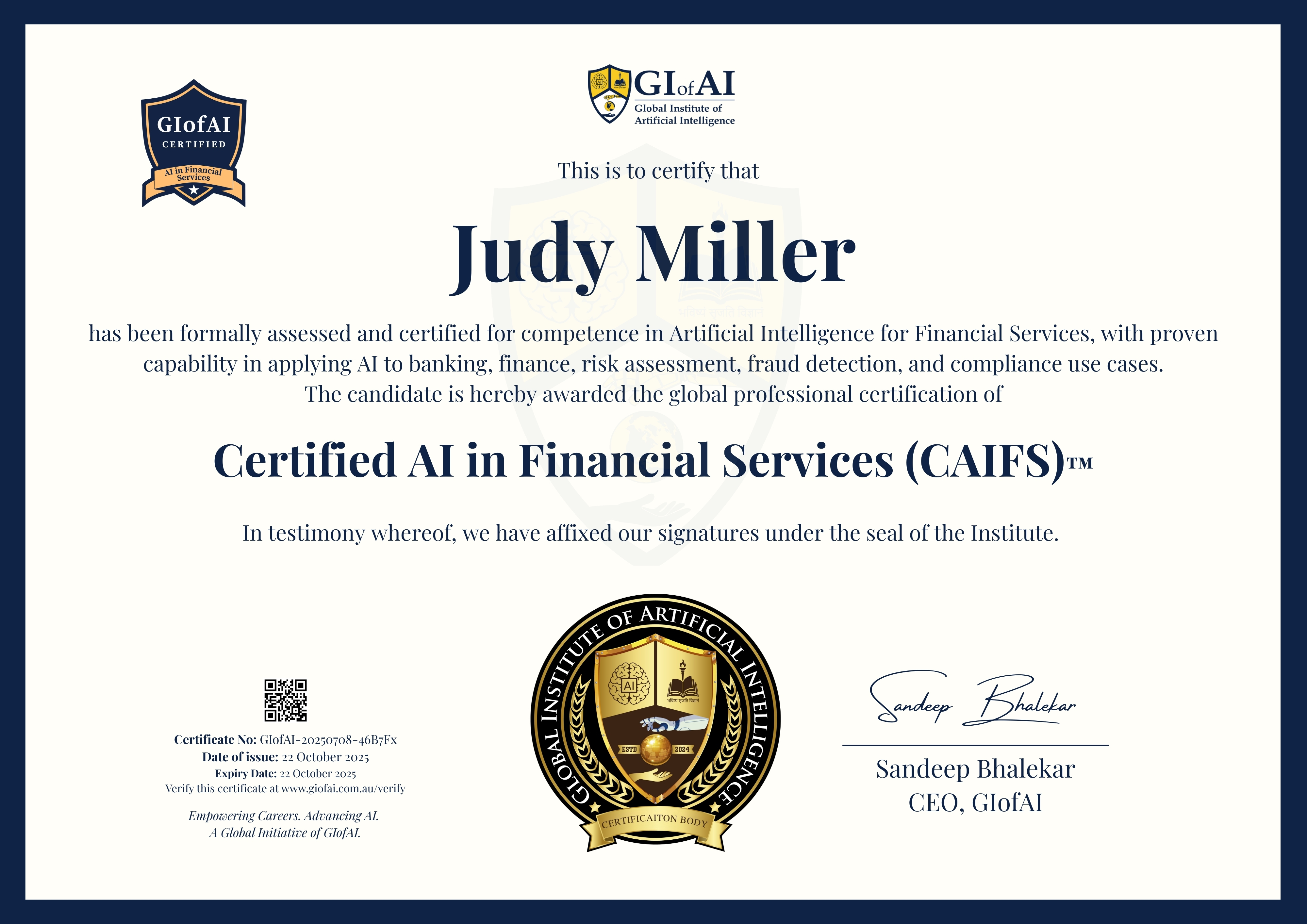
Your professional certification credential, verifiable and shareable.
Frequently Asked Questions
A few common questions about format, preparation, and expectations.
Yes. The assessment is designed to be closed book with no external assistance, supporting a consistent baseline of verified capability.
All questions are multiple choice (A–D) with a single correct answer. Some items are scenario-based, but they are still answered via standard MCQ selection.
Each question carries equal weight. There is no negative marking. The passing threshold is 70%.
Candidates may retake up to two times within six months of the first attempt. A separate purchase is required for each retake, and a 7-day wait is recommended between attempts.
Reasonable accommodations may be supported (e.g., extended time or additional breaks). Requests typically require documentation and should be submitted in advance of the scheduled assessment.
The assessment is intended for professionals applying AI/ML in financial services or learners with equivalent experience in AI fundamentals, data work, and governance concepts.
AI responsibly in financial services
CAIFS is built to assess applied decision-making across use cases, risk, governance, and ethics—so your credential signals competence that matters in regulated environments.

Career Path
A progression from entry to leadership, aligned with certifications.
Entry-Level Roles
- AI Practitioner
- Junior AI Engineer
- Data Analyst / AI Technician
Intermediate Roles
- Machine Learning Engineer
- Data Scientist
- Generative AI Developer
- Computer Vision Engineer
- Cloud AI Engineer
- Responsible AI Specialist
Advanced Roles
- AI Consultant (Finance, Healthcare, Manufacturing, etc.)
- AI Solutions Architect
- AI Research Engineer
- AI Security & Privacy Specialist
Leadership Roles
- AI Product Manager
- Head of AI / Director of Data Science
- AI Transformation Officer
- Chief AI Officer (CAIO)
- AI Governance & Risk Director
Entry-Level Roles
- AI Practitioner
- Junior AI Engineer
- Data Analyst / AI Technician
Advanced Roles
- AI Consultant (Finance, Healthcare, Manufacturing, etc.)
- AI Solutions Architect
- AI Research Engineer
- AI Security & Privacy Specialist

Intermediate Roles
- Machine Learning Engineer
- Data Scientist
- Generative AI Developer
- Computer Vision Engineer
- Cloud AI Engineer
- Responsible AI Specialist
Leadership Roles
- AI Product Manager
- Head of AI / Director of Data Science
- AI Transformation Officer
- Chief AI Officer (CAIO)
- AI Governance & Risk Director
Career Growth Ladder
| Level | Typical Roles | Relevant Certifications |
|---|---|---|
| Entry-Level | AI Technician, Data Analyst | CAIP |
| Mid-Level | AI Engineer, ML Engineer, AI Developer | CAIE, CRAIS, CGAIS |
| Advanced | AI Architect, AI Consultant, Security Specialist | CLLMS, CCVE, CAICE, CAISPS, Industry Certs |
| Leadership | Head of AI, AI Product Manager, CAIO | CAIL, CAITO, CAIGR, CEAIR |

Certification Pathway
GlofAI Learning Path (Certification Progression)
Stage 1 — Foundation
Stage 2 — Core AI Competency
- Certified AI Engineer (CAIE) – Core technical certification.
- Certified Responsible AI Specialist (CRAIS) – Ethics, bias mitigation, compliance.
- Certified Generative AI Specialist (CGAIS) – Prompt engineering, generative AI tools.
Stage 3 — Specialized Technical Expertise
- Certified LLM Specialist (CLLMS) – NLP & Large Language Models.
- Certified Computer Vision Expert (CCVE) – Imaging, video analytics, AR/VR.
- Certified AI Cloud Engineer (CAICE) – AI on AWS, Azure, GCP, Databricks.
- Certified AI Security & Privacy Specialist (CAISPS) – AI risks, privacy, cybersecurity.
Stage 4 — Industry-Specific Applications
- Finance & Banking: Certified AI in Financial Services (CAIFS)
- Healthcare: Certified AI in Healthcare (CAIH)
- Retail & Supply Chain: Certified AI in Retail & Supply Chain (CAIRSC)
- Manufacturing: Certified AI in Manufacturing (CAIM)
- Public Sector & Policy: Certified AI in Policy & Governance (CAIPG)
Stage 5 — Executive & Enterprise Leadership
- Certified AI Leader (CAIL) – Strategic, leadership-level AI management.
- Certified AI Transformation Officer (CAITO) – C-suite strategy & transformation.
- Certified Enterprise AI Ready (CEAIR) – AI governance framework for organizations.
- Certified AI Governance & Risk Expert (CAIGR) – Compliance & regulatory strategy.

Stage 1 — Foundation
Goal: Build baseline AI knowledge and confidence.
Certified AI Practitioner (CAIP) – Foundational skills in AI, data, and ML.
Stage 2 — Core AI Competency
Goal: Master model development and deployment.
- Certified AI Engineer (CAIE) – Core technical certification.
- Certified Responsible AI Specialist (CRAIS) – Ethics, bias mitigation, compliance.
- Certified Generative AI Specialist (CGAIS) – Prompt engineering, generative AI tools.
Stage 3 — Specialized Technical Expertise
Goal: Deep dive into specific domains of AI technology.
- Certified LLM Specialist (CLLMS) – NLP & Large Language Models.
- Certified Computer Vision Expert (CCVE) – Imaging, video analytics, AR/VR.
- Certified AI Cloud Engineer (CAICE) – AI on AWS, Azure, GCP, Databricks.
- Certified AI Security & Privacy Specialist (CAISPS) – AI risks, privacy, cybersecurity.
Stage 4 — Industry-Specific Applications
Goal: Apply AI to real-world sectors.
- Finance & Banking: Certified AI in Financial Services (CAIFS)
- Healthcare: Certified AI in Healthcare (CAIH)
- Retail & Supply Chain: Certified AI in Retail & Supply Chain (CAIRSC)
- Manufacturing: Certified AI in Manufacturing (CAIM)
- Public Sector & Policy: Certified AI in Policy & Governance (CAIPG)
Stage 5 — Executive & Enterprise Leadership
Goal: Lead AI strategy and enterprise adoption.
- Certified AI Leader (CAIL) – Strategic, leadership-level AI management.
- Certified AI Transformation Officer (CAITO) – C-suite strategy & transformation.
- Certified Enterprise AI Ready (CEAIR) – AI governance framework for organizations.
- Certified AI Governance & Risk Expert (CAIGR) – Compliance & regulatory strategy.
| Level | Focus | Example Certifications |
|---|---|---|
| Beginner | Foundations | CAIP |
| Intermediate | Core AI Skills | CAIE, CRAIS, CGAIS |
| Advanced | Specialized Technical | CLLMS, CCVE, CAICE, CAISPS |
| Expert | Industry Applications | CAIFS, CAIH, CAIRSC, CAIM, CAIPG |
| Leader | Strategic & Enterprise | CAIL, CAITO, CEAIR, CAIGR |